The article provides a comprehensive comparison of hospitality software companies, focusing on their features, pricing, and benefits—elements crucial for informed decision-making in the industry. By highlighting key criteria such as:
it offers valuable insights into the advantages of leading software solutions. This analysis underscores the importance of selecting the right tools to enhance operational efficiency and customer satisfaction.
In today’s competitive landscape, hotel and restaurant owners face numerous challenges. Understanding the functionality and integration capabilities of various software options can significantly impact operational success. Furthermore, the article delves into how customer support and data security are paramount in choosing a software provider.
Ultimately, the insights presented serve as a guide for hospitality professionals aiming to elevate their business through informed technology choices. By prioritizing the right software, businesses can not only streamline operations but also improve customer experiences, driving long-term success in the hospitality sector.
In an industry where guest satisfaction is paramount, selecting the right hospitality software can make or break a business. The multitude of options available necessitates a thorough understanding of essential features, pricing structures, and the benefits of leading solutions. For hotel and restaurant operators looking to enhance their operations, this knowledge is crucial.
However, with so many choices, how can one navigate the complexities of functionality, integration, and cost-effectiveness? It is imperative to ensure that the best decision is made for their unique needs.
When comparing hospitality software, several key criteria warrant careful consideration:
Functionality: The software must address the specific operational needs of hotels and restaurants, encompassing booking management, customer relationship management (CRM), and revenue management. As Richard Branson aptly stated, 'The key is to set realistic customer expectations and then not to just meet them, but to exceed them.' This underscores the critical role of functionality in not only meeting but exceeding visitor expectations.
User Experience: An intuitive interface is paramount for effective staff training and enhancing customer satisfaction. Software that is easy to navigate can significantly boost operational efficiency. J. Willard Marriott emphasized that 'It's the little things that make the big things possible,' highlighting the importance of user experience in achieving operational excellence.
Integration Capabilities: The capacity to integrate with existing systems—such as POS systems, channel managers, and CRM tools—is essential for seamless operations. SiteMinder's tools for personalizing guest experiences exemplify how effective integration can elevate operational efficiency and guest satisfaction.
Scalability: As businesses grow, their application requirements evolve. Solutions must be scalable to accommodate growth without necessitating a complete overhaul. This adaptability is vital in a dynamic industry.
Customer Support: Reliable customer assistance is crucial for swiftly resolving issues and ensuring that the application operates seamlessly. The significance of support cannot be overstated, as it directly influences service quality.
Data Security: With the sensitive nature of customer data, robust security measures are imperative to safeguard against breaches. The hospitality industry increasingly depends on data-driven insights, making security a top priority.
These criteria will empower stakeholders to make informed choices when selecting hospitality solutions that align with their operational objectives and customer service standards.

Leading hospitality software companies provide expertly crafted solutions to streamline operations and elevate visitor experiences through a range of essential features that play a pivotal role in effective hotel marketing strategies. Key components include:
These features are indispensable for hotels and restaurants aiming to enhance efficiency and cultivate deeper customer engagement, particularly as hospitality software companies adapt in 2025.
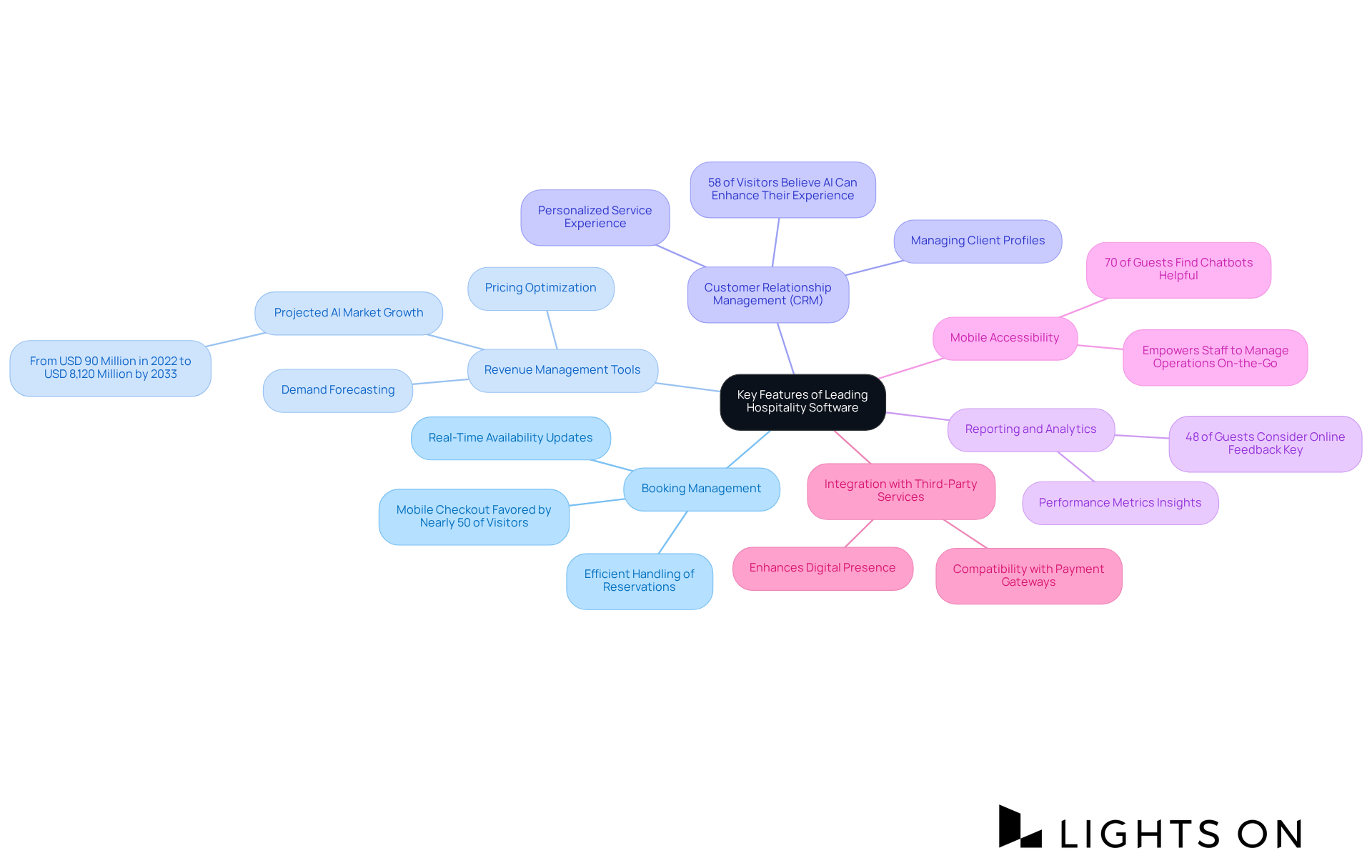
Pricing structures for hospitality software companies exhibit considerable variation, influenced by features, scalability, and service levels. Understanding these pricing structures is crucial for hospitality software companies aiming to evaluate their options effectively. The primary models include:
Subscription-Based Pricing: This model involves monthly or annual fees that grant access to the software, often tiered according to the number of users or included features. Subscription-based pricing is increasingly favored in 2025, as it simplifies cost allocation and provides smaller businesses access to tools they might otherwise find unaffordable. Notably, over 45% of businesses allocate 5% to 10% of their revenue on hotel management systems. However, it is crucial to recognize that although initial costs may be lower, long-term expenses can exceed those of perpetual licenses after three to five years, especially if the implementation proves successful. Subscription license costs will generally exceed perpetual license costs during this timeframe.
One-Time Licensing Fees: This arrangement necessitates a one-time payment for indefinite use of the application. While it eliminates ongoing subscription costs, businesses must budget for additional expenses related to updates and support, which can accumulate over time.
Pay-Per-Use Models: This flexible approach charges companies based on actual application usage, making it advantageous for those with fluctuating demand. It allows for cost efficiency but may lead to unpredictability in budgeting.
Freemium Models: Providing basic features at no cost, this model enables companies to evaluate the application before investing in premium features that come with a charge. This can be an effective way to assess the program's fit for specific operational needs.
As industry leaders emphasize, hospitality software companies should take into account not only immediate costs but also long-term operational efficiency and customer satisfaction when deciding between subscription and perpetual licensing. Additionally, it is important to be aware of potential additional costs associated with subscription models, such as training, ongoing support, and updates, which can represent significant overhead for larger establishments. As Debby noted, there is skepticism about whether subscription-based licensing guarantees excellent customer experience and satisfaction, highlighting the need for careful consideration in the decision-making process.

Investing in leading hospitality software companies, particularly those offered by Lights On, brings forth numerous benefits that are essential for thriving in the competitive landscape of 2025.
Enhanced Operational Efficiency: Streamlined processes significantly reduce manual tasks and errors, allowing staff to dedicate more time to guest service. For instance, 64% of hotels are utilizing AI for housekeeping scheduling, which has reduced room turnover time by 41%. Lights On's software integrates AI-enabled workflows, crucial for improving operational efficiency.
Enhanced Visitor Experience: Customized services and effective reservation processes lead to greater visitor satisfaction and loyalty. A significant 77% of accommodation patrons express interest in automated messaging or chatbots for customer support, indicating a strong demand for seamless interactions. Lights On's solutions facilitate these interactions, thereby enhancing the overall guest experience.
Data-Driven Decision Making: Access to real-time analytics empowers businesses to make informed decisions that enhance profitability. The integration of AI and data analytics in Lights On's software revolutionizes how hotels enhance pricing and customize marketing strategies, with a projected CAGR of 8.6% for the global hotel software sector from 2025 to 2032.
Increased Revenue: Effective revenue oversight tools within Lights On's offerings help optimize pricing strategies, leading to improved occupancy rates and higher average daily rates (ADR). The property administration system (PMS) segment is anticipated to lead the market, possessing an estimated share of 27.7% in 2025, highlighting its significance in revenue optimization.
Competitive Advantage: Utilizing advanced technology from Lights On can differentiate a business in a crowded market, attracting more customers. The emphasis on direct reservations and eCommerce development is propelling the expansion of the hotel management sector, with Lights On at the forefront.
These benefits clearly illustrate why investing in the right hospitality software companies, particularly from Lights On, is crucial for long-term success in the industry.

Selecting the right hospitality software is crucial for businesses aiming to enhance their operational efficiency and customer satisfaction. This article has explored the essential criteria for evaluating hospitality software, including:
Each of these elements plays a vital role in ensuring that the software not only meets operational demands but also elevates the overall guest experience.
Key features such as booking management, revenue management tools, customer relationship management, and mobile accessibility are indispensable components that leading hospitality software companies should offer. Furthermore, understanding the various pricing structures—subscription-based, one-time licensing fees, pay-per-use models, and freemium options—enables businesses to make informed financial decisions that align with their long-term strategy.
Ultimately, the benefits of investing in top-tier hospitality software cannot be overstated. Enhanced operational efficiency, improved visitor experiences, data-driven decision-making, increased revenue, and a competitive advantage are all significant outcomes that arise from leveraging the right technology. As the hospitality industry continues to evolve, prioritizing the right software solutions will be essential for businesses looking to thrive in this dynamic landscape. Embracing these advancements can lead to sustained success and greater customer loyalty in the years to come.
What are the key criteria for comparing hospitality software?
The key criteria include functionality, user experience, integration capabilities, scalability, customer support, and data security.
Why is functionality important in hospitality software?
Functionality is crucial as it must address the specific operational needs of hotels and restaurants, including booking management, CRM, and revenue management, to meet and exceed customer expectations.
How does user experience impact hospitality software?
An intuitive user experience is essential for effective staff training and enhancing customer satisfaction, which can significantly boost operational efficiency.
What role do integration capabilities play in hospitality software?
Integration capabilities are vital for seamless operations, allowing the software to connect with existing systems like POS systems, channel managers, and CRM tools.
Why is scalability important for hospitality software?
Scalability is important because as businesses grow, their application requirements change. The software must adapt without requiring a complete overhaul.
How does customer support affect hospitality software?
Reliable customer support is crucial for quickly resolving issues and ensuring the software operates smoothly, which directly influences service quality.
What measures should be taken to ensure data security in hospitality software?
Robust security measures are imperative to protect sensitive customer data from breaches, making data security a top priority in the hospitality industry.
Transform your group booking strategies with Lights On and watch your occupancy soar.


.svg)

